

Digital circuits beat analog circuits on noise immunity, exact copying and storage, programmability, and the cost and density benefits of CMOS scaling. They work because each signal only has to be read as a 0 or a 1, so small amounts of noise, drift and component tolerance are simply ignored. Analog circuits still matter at the edges of every system, where real-world signals are sensed, amplified, converted and driven, but almost all processing and storage in between is now digital.
Key takeaways
- A digital gate restores a clean 0 or 1 at every stage, so noise does not build up through a long chain the way it does in analog.
- Digital precision is set by the number of bits you choose to carry, not by component tolerance. Each extra bit adds about 6 dB of dynamic range.
- Digital data can be copied, stored and sent any number of times with no loss, and error-correcting codes repair the occasional bit error.
- The same silicon can do different jobs through software or reconfiguration, and digital logic shrinks well with each process node.
- Analog is still needed for sensing, conversion, power and RF. A real system is a digital core wrapped in a thin analog shell.
How digital and analog circuits differ
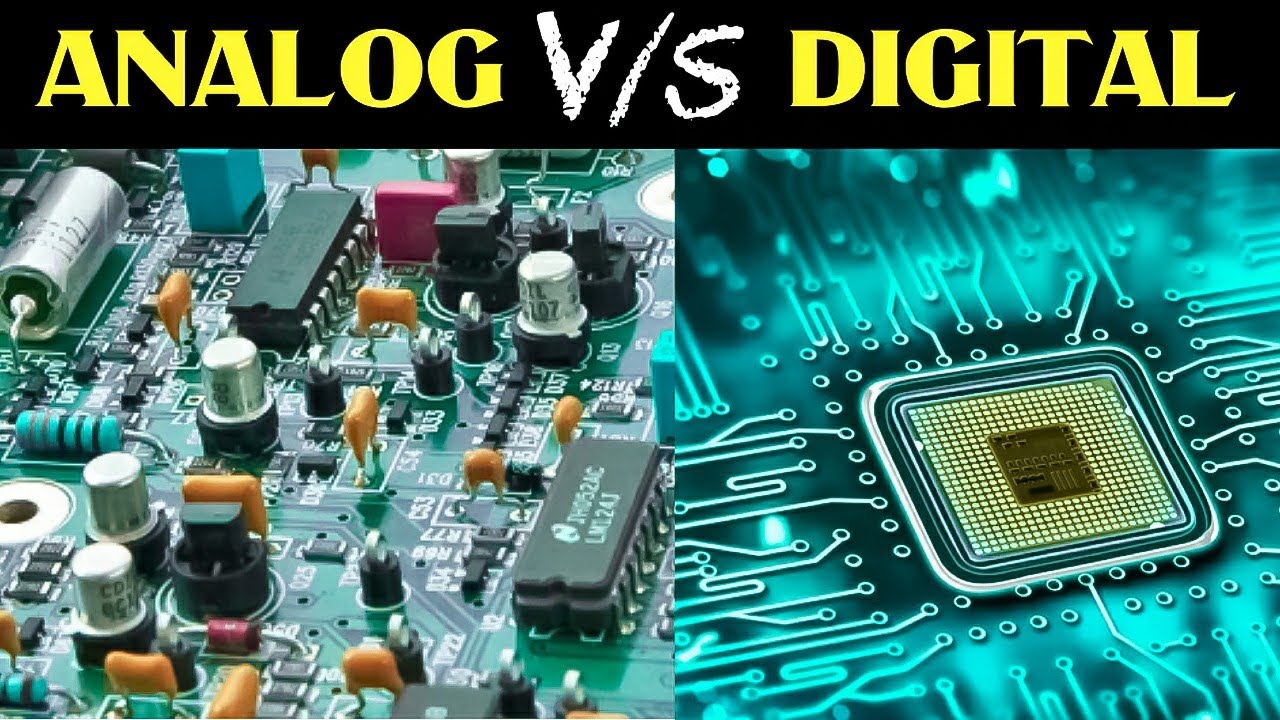
An analog circuit represents information as a continuously variable voltage or current. A microphone preamplifier, for example, produces an output voltage that follows the sound pressure moment by moment. Every millivolt of the output carries meaning, so every millivolt of noise or distortion changes the result.
A digital circuit represents information as discrete levels, almost always two: a voltage near ground means 0 and a voltage near the supply means 1. Anything in between is a forbidden zone the design avoids. Because a logic gate has very high gain around its switching threshold, it pushes a slightly noisy input back to a full-swing output. This regeneration at every stage is the root of most of the advantages below.
The top 10 advantages of digital circuits
1. Noise immunity
Digital signals are less susceptible to noise and interference, which makes them more reliable. Each logic family defines a noise margin: the amount of noise a signal can pick up and still be read correctly. For the common 3.3 V LVTTL-compatible levels in JEDEC JESD8C, an output guarantees at least 2.4 V for a 1 and at most 0.4 V for a 0, while an input accepts anything above 2.0 V as 1 and below 0.8 V as 0. That leaves a 0.4 V margin on each side.
Worked example. Suppose 200 mV of crosstalk couples onto a 3.3 V logic line. The digital receiver still sees a 1 (2.4 V minus 0.2 V is 2.2 V, above the 2.0 V threshold) and outputs a perfectly clean 3.3 V. On an analog line carrying a 1 V full-scale signal, the same 200 mV is a 20 percent error that no later stage can remove.
2. Signal processing
Digital signals can be processed using digital circuits, which allows complex operations such as filtering, modulation and demodulation. A digital filter is a set of multiplications and additions on samples, so its response is exactly what the coefficients say. It does not drift with temperature or age, and it can implement things that are very hard in analog, such as linear-phase FIR filters, adaptive equalisers and FFT-based processing in Wi-Fi, 5G and audio codecs.
3. Precision
The precision of a digital system is chosen by the designer, through the number of bits, rather than limited by resistor and capacitor tolerances. An ideal N-bit converter has a signal-to-quantisation-noise ratio of about 6.02N + 1.76 dB.
Worked example. A 12-bit representation gives about 74 dB, and a 16-bit one, as used on audio CDs, about 98 dB. Inside the digital domain the arithmetic can carry even more bits, so repeated calculations do not lose accuracy. An analog circuit built from 1 percent resistors, by contrast, has a gain error in the order of 1 percent before any trimming.
One caveat: digital precision is only as good as the analog-to-digital converter at the input. The converter's own noise and linearity set the real accuracy of the whole chain.
4. Storage
Digital data can be stored and retrieved using digital memory, so large amounts of data fit in a compact form. SRAM, DRAM and flash store bits with very high density, and a stored value can be held indefinitely (refreshed in DRAM, retained for years in flash). Storing an analog value faithfully, on a capacitor or magnetic tape, is limited by leakage and noise, and it degrades with time.
5. Reproducibility
Digital signals can be reproduced and transmitted without loss, which suits long-distance communication. More precisely, digital signals do weaken and pick up noise along a cable or radio link, but a repeater or receiver can regenerate the original bits exactly as long as the noise stays within the margin. Error-detecting and error-correcting codes then catch or fix the rare bits that are wrong. A copy of a copy of a digital file is identical to the original, while each generation of an analog tape copy adds hiss and loses high frequencies.
6. Flexibility
Programmable digital circuits can be reprogrammed and modified, which gives far more flexibility in design. A microcontroller or DSP changes function with new firmware, and an FPGA can be reconfigured into different hardware. Even fixed ASICs usually carry register settings and firmware that let one chip serve many products. Changing an analog circuit's behaviour normally means changing components on the board.
7. Scalability
Digital circuits scale up or down to suit a wide range of applications. The same standard-cell design flow builds a few thousand gates for a sensor hub or tens of billions of transistors for a GPU. Digital logic also benefits most from process scaling: smaller transistors make gates faster, smaller and lower in energy per operation, while analog circuits often need larger devices to keep matching and noise under control.
8. Cost
Digital circuits can be made at lower cost than analog circuits, especially in large production runs. Design is highly automated (synthesis, place and route, static timing analysis), digital blocks are portable between foundries and nodes, and logic density keeps rising, so the cost per function falls with volume. This is a general trend rather than a rule: a small analog part on a mature node can be cheaper than a digital equivalent, and the analog content of a mixed-signal chip often takes a large share of the design effort.
9. Compatibility
Digital circuits are compatible with modern computing systems, which makes them well suited to working with software. Data in binary form can be handed directly to a processor, logged, analysed and updated over the air. Analog signals have to be converted first.
10. Integration
Digital circuits integrate easily with other digital systems, such as microcontrollers and computers, through standard interfaces like I2C, SPI, UART, USB and Ethernet. This allows reliable communication and control between chips and boards built by different vendors.
Summary table
| Property | Digital circuits | Analog circuits |
|---|---|---|
| Signal form | Discrete levels (0 and 1) | Continuous voltage or current |
| Noise | Rejected within the noise margin, restored at each gate | Adds up through every stage |
| Precision | Set by the number of bits | Set by component tolerance, noise and drift |
| Copying and storage | Exact, with error correction | Degrades with each copy and over time |
| Changing function | Firmware or reconfiguration | Usually new components |
| Process scaling | Benefits strongly | Benefits less, sometimes harmed |
| Design automation | Highly automated | Largely hand-crafted |
Where analog still wins
The real world is analog, so every digital system needs analog circuits at its boundary. Analog remains the better or only choice for:
- Sensing and amplification: microphones, image sensor pixels, thermocouples and strain gauges produce tiny analog signals that need low-noise amplifiers.
- Data conversion: ADCs and DACs are mixed-signal circuits whose quality limits the whole system.
- RF: antennas, low-noise amplifiers, mixers and power amplifiers handle signals at gigahertz frequencies.
- Power: voltage regulators, battery chargers and motor drivers are analog and power circuits.
- Very simple or very fast functions: a single RC filter or comparator can be smaller, cheaper and lower in power than digitising a signal and processing it.
Digital also has costs of its own: switching activity draws dynamic power, sampling introduces quantisation error and aliasing if the input is not filtered, and the converters add latency.
Common misconceptions
- "Digital signals never degrade." They do degrade on a wire. The advantage is that they can be regenerated exactly while the noise is below the margin.
- "Digital is always more accurate." Only to the extent the ADC and sample rate allow. A poor converter makes a poor digital system.
- "Analog is obsolete." Analog design is a smaller share of transistors but often the hardest part of a chip to get right.
FAQ
Why are digital circuits more immune to noise?
Because the receiver only decides between two levels and each gate regenerates a full-swing output, any noise smaller than the noise margin is removed rather than passed on.
Are digital circuits always cheaper than analog?
Not always. In high volume, digital logic is usually cheaper per function because of automation and process scaling, but a simple analog function on a mature process can cost less than its digital equivalent.
Can a system be fully digital?
No. Sensors, power supplies, clocks and radios all involve analog circuits. Most modern chips are mixed-signal: a large digital core with analog blocks at the edges.
What is the main disadvantage of digital circuits?
They need conversion to and from the analog world, which adds cost, latency and quantisation error, and high-speed digital logic can consume significant power.

Your comments will be moderated before it appears here.